IllusoryThrall's Sims 4 Hub
- Challenges, Tips & Stories
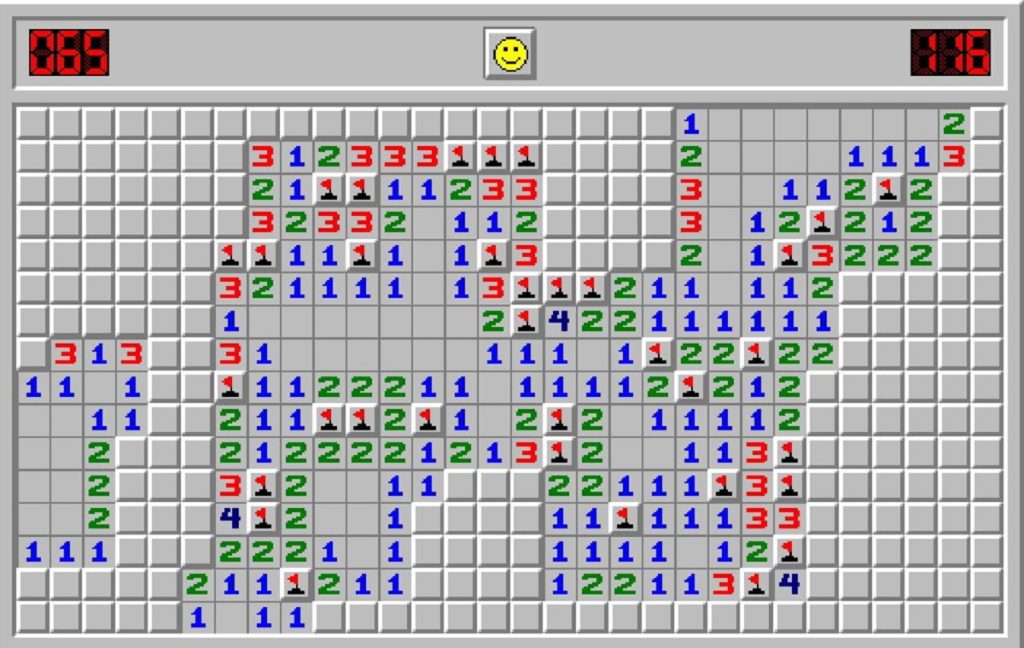

I would be very remiss if I didn’t mention the classic game “Minesweeper” at least once in this year’s game retrospective. As I’ve mentioned, my early history with games was very limited. Tetris and Minesweeper, (and to a lesser extent Solitaire and Freecell) however, were part of my early game education. I very much remember competing with my dad for high score on the family’s computer. I could never beat him in solitaire or freecell, and rarely in Tetris, but for some reason, I COULD beat him in Minesweeper. So I did. repeatedly. I usually played on “Expert” and he had the worst time trying to keep up with me on times. (Which was a big thing, because he usually won at EVERYTHING!)
Minesweeper, as a computer game, has been around a LONG time. The game itself originates sometimes in the 1960s, and is a single-player game that involves clearing a rectangular board containing hidden “mines” or bombs without blowing any of them up using clues you find on the board. An easy board seems over simplified, but I assure you, the difficulty ramps up quite significantly when you start going to bigger boards and higher difficulties. The numbers you uncover refer to how many mines that square is touching, and you use logic to figure out where they are.
The game I played was first put out by Microsoft in 1990, and was also released as a standard part of Windows 3.1 in 1992. In fact, until Windows 8 (2012), the game was still an automatic part of your Windows Operating System.
As I said above, my main interest in this game was beating my Dad’s high scores.. but it definitely taught me to be competitive when it comes to games. I did spend many hours playing it, though, and I loved being able to finally succeed at games vs. my Dad, so this was definitely one of the high points of my early gaming history.
If you’re into logic puzzles, there are plenty of free versions of Minesweeper still out there as a phone or PC or Mac app, so look it up and see how many hours you lose. *wink*

 BIG ANNOUNCEMENT!!
 Chapter One – Starting Anew
 November 2025 Dev DiarySuperSweetBot Commands for Mods & BroadcastersOctober 2025 Dev DiaryProgress Report!Hacking Situation ResolvedHey all…
 Welcome to my new webhost!!
 Progress Report on Not So Berry & TimelineExtended Not So Berry 2.0 is coming!!
 OMG A Thrall Post?? What?Not So Berry Updating
 Jaynie’s Gems: By-The-NumberToday